
Solar railways and stork villages: Positive environmental stories from 2026
With powerful nations rolling back climate protections and temperatures soaring ever closer to dangerous thresholds, it's hard not to feel worried about the state of the planet. As green journalists, climate...
With powerful nations rolling back climate protections and temperatures soaring ever closer to dangerous thresholds, it's hard not to feel worried about the state of the planet.
As green journalists, climate anxiety, climate doom and even environmental existential dread are a daily presence.
These terms all describe the negative feelings, such as stress, fear, anger and grief, that confront us when the reality of a warming Earth hits home. With almost daily stories of destruction and loss of life due to extreme weather, it’s impossible to escape the impacts of climate change.
Rather than being paralysed by helplessness, though, experts suggest that we channel these feelings into action.
At Euronews Earth, we know we play a key role in combatting climate doom. While it’s our job to be truthful and accurate in our reporting and not downplay or greenwash the realities, we also want to remind you that there is always hope.
This is why, for the past four years, we’ve kept a roundup of positive environmental news. Every year we cover hundreds of good news stories, from eco-innovations and green breakthroughs to climate wins and feel-good reports on nature.
Here are this year's top positive stories so far - including the small and local, the silly that made us smile - and the enormous and potentially world-changing.
If you came across a great, positive story that we haven't covered, please reach out to us on Instagram or X to share your ideas.
Positive environmental stories from July 2026
Cooling your home and lessening eco-anxiety: What are the hidden benefits of rooftop solar panels?
Solar has been described as a “shining star” of the EU’s energy transition, helping to shelter households from the crippling cost of fossil fuels.
But aside from lowering our energy bills and weaning Europe away from polluting oil and gas – adding rooftop solar panels to your home comes with a host of hidden benefits.
Italy could be the next country to build a solar railway after Switzerland’s successful trial
Europe’s infrastructure is embracing the renewables boom, with one company determined to transform the continent’s railway lines into mini solar farms.
Last year, Swiss start-up Sun-Ways unveiled the world’s first-ever solar railway after rolling out 100 metres of photovoltaic (PV) panels in between active tracks in Buttes, a village in the Val-de-Travers district.
Denmark, Portugal, Lithuania lead the way as EU share of electricity from renewables hits 46%
The EU’s share of electricity generated from renewables continues to grow, new Eurostat data reveals.
In the first quarter of 2026, it reached 45.5 per cent of the total electricity generated. This is up from 42.7 per cent in the same period in 2025.
Pigeons, frogs and beetles gather in Milan City Hall to debate the rights of urban animals
Humans wearing animal masks gathered at Milan City Hall for the first Parliament of Living Species this month. Their goal was to convince policymakers to consider the creatures they represented when making decisions about what to build and where in Italy’s second biggest city.
Air quality is improving across Europe as report finds ‘steady decrease’ in major pollutants
Europe’s air quality is getting better, despite “persistent pollution episodes” threatening to halt progress.
The EU’s Copernicus Atmosphere Monitoring Service (CAMS) says in its latest report that while some parts of the continent are still experiencing issues with local air pollution the overall outlook “remains encouraging”.
'The storks were here before me': Pensioners live side-by-side with storks in this Croatian village
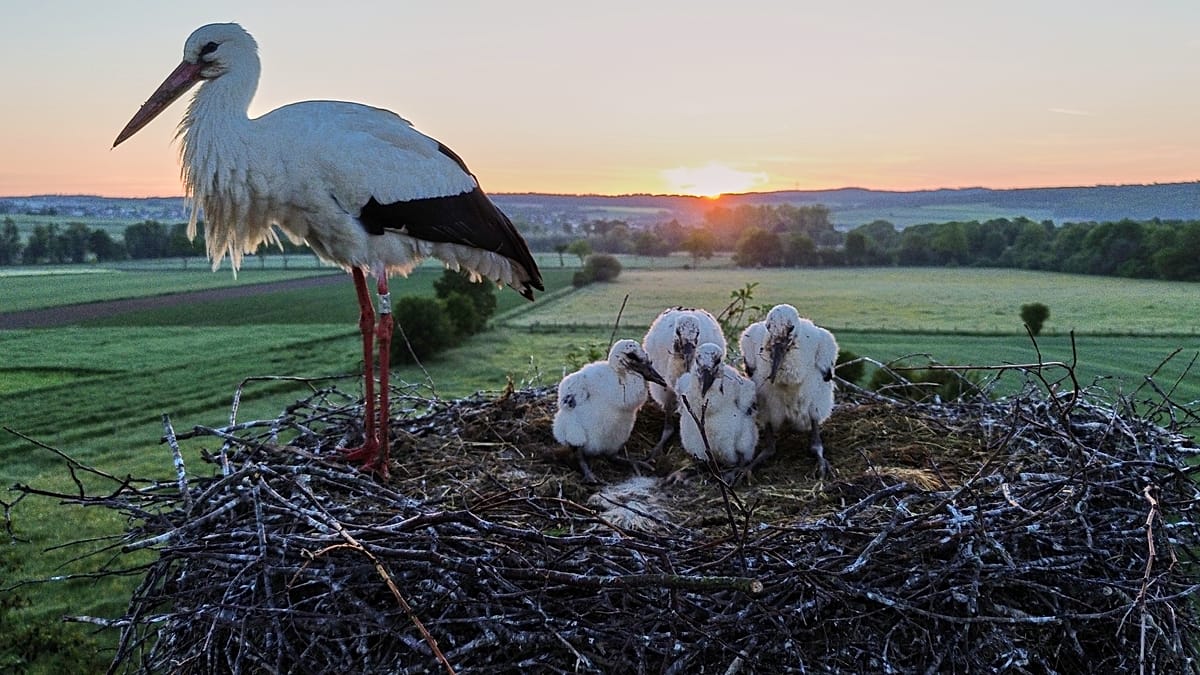
In the Croatian village of Cigoc, storks are not just visitors – they are residents. Each spring, white storks return from Africa to nest on the rooftops of the village's traditional wooden houses, in such numbers that they regularly outnumber the people who live there.
Positive environmental stories from June 2026
Europe’s heat pumps replace Middle East gas imports twice over. Which country is leading the way?
Heat pump sales have soared across Europe, cushioning households from the crippling costs of gas amid the war on Iran.
According to a new analysis from the European Heat Pump Association (EHPA), the continent’s heat pumps provide as much heat as the liquified natural gas (LNG) carried by more than 200 tankers.
Europeans are making the most of cheap solar panels – by creating green garden fences
Solar fences are gaining ground in Europe, as households continue to invest in renewables amid the war on Iran.
Glow-in-the-dark plants warn of crop pests
A team of Spanish researchers has created plants that glow in the dark and change colour when infected, allowing early detection of crop pests and diseases with ordinary cameras.
Solar-powered fridges are boosting farmers’ incomes by 50% while cutting food waste
Solar-powered, off-grid cold rooms, warehouses and cooling hubs allow farmers and traders to preserve perishable goods without relying on expensive and unreliable electricity grids. This shift is gaining momentum across Kenya, Nigeria, Ethiopia, Rwanda and South Africa.
Spain’s renewables revolution is paying off: Electricity bills are lower despite energy crisis
Spain’s electricity bills have fallen while many other countries have seen a rise since the energy crisis caused by the outbreak of the Iran war.
New analysis shows that households have each saved €10 per month on their electricity bills since the Hormuz strait was effectively closed in March. Thanks to the country’s commitment to the clean energy transition, renewables have reduced the influence of fossil fuels on the electricity price by 75 per cent since 2019.
France adds 157,000 hectares of protected forest
France has created seven new biological reserves and expanded two existing ones. Together, they safeguard an additional 157,000 hectares of forest as it works toward placing 10 per cent of its land under ‘strong protection’ by 2030.
‘Coal power has lost its status’: Solar power outstrips coal in US despite Trump's attacks
Even as President Donald Trump boosts coal over clean energy, solar power is hitting new milestones in the US and remains the leading source of new power.
Positive environmental stories from May 2026
‘Even a five-year-old can do it’: Collecting river water samples helps map life on 10% of Earth
Combatting wildlife decline, eDNA technology is turning simple water and soil samples into a global biodiversity map.
Clean energy saved EU €51 billion in 2025 by cutting fossil fuel imports - as solar leads the way
Europe made huge energy cost savings in 2025 thanks to reducing its dependence on polluting fossil fuels by driving investment in renewables.
Using wind and solar to generate power meant significantly less reliance on imported oil and gas, according to energy think tank Ember.
From fur to data: How eDNA is revolutionising wildlife monitoring in Africa
Scientists in Rwanda's misty Volcanoes National Park are turning to a new tool to protect endangered mountain gorillas and golden monkeys: environmental DNA.
Known as eDNA, the technology identifies species using genetic traces – fur, faeces – left in soil and water, eliminating the need for researchers to physically locate the animals.
Pee for the planet: How football fans are tackling Sweden’s fertiliser problem using urine
Eleda Stadion, home of Malmö FF, opened its doors – and its toilets – on 24 May to an initiative aiming to gather 1,000 litres of human urine.
The goal? To defeat Sweden’s dependence on imported fossil fuel-based synthetic fertilisers, which generate 1.13 billion tonnes of CO2 equivalents annually.
'Turning crisis into opportunity': How Lithuania became a wild card in the EU's clean energy race
Lithuania has rapidly become a renewables powerhouse after drastically reducing its reliance on polluting fossil fuels.
The country’s domestic consumption of renewable electricity jumped from 15 per cent five years ago to 50 per cent in 2025, thanks to huge investment in solar and wind.
Petrostates tried to squash this historic climate ruling. The UN just voted to back it
Defying efforts by the US to have it withdrawn, a landmark resolution on the legal obligations of countries to protect the planet from climate change has passed a critical next step.
The UN General Assembly voted overwhelmingly on 20 May to support strong action to limit climate change despite fierce campaigning against it by fossil fuel producing countries.
EU households could save ‘more than €2,200’ every year by switching to heat pumps and EVs
Switching to green heating and transport can cut EU household energy bills by thousands of euros every year, even before accounting for fossil fuel shocks, according to a new report.
Meet the 18-year-old whose prize-winning invention takes on the microplastics emergency
At just 18-years-old, Ayra Satheesh is taking on one of the biggest environmental challenges of our time.
The Irish student was on 11 May announced as the European winner for the prestigious Earth Prize, the world’s largest environmental competition that empowers young people with mentorship and $100,000 (€85,000) in funding.
'David Attenborough Effect': Meet the wildlife artists inspired by the legendary broadcaster
Sir David Attenborough will likely go down in history as the most treasured wildlife broadcaster on planet Earth – and this May, he turned 100.
Artists Skip and Katherine Khangurra lives were changed by the so-called 'Attenborough effect', describing how the issues he highlights in his work bring about real change.
'They know they’re safe’: 1,500 beagle dogs start new lives after being rescued from research lab
1,500 beagle dogs have been set free from a breeding and research facility after animal groups paid for them to be released.
'This animal has given us a sense of identity’: Iconic kiwi birds return to New Zealand's capital
The kiwi, New Zealand’s sacred national bird, vanished from the hills around Wellington more than a century ago. Now the capital's residents are waging an improbable citizen campaign to return the endangered flightless birds to the city.
Positive environmental stories from April 2026
‘Time to move forward, or be left behind’: Colombia climate talks end with fossil fuel phaseout push
The current energy crisis has exposed how deeply countries remain dependent on imported fossil fuels – and the risks that come with it. Against this backdrop, 56 countries gathered in Santa Marta, Colombia, for the first international conference dedicated to mapping a fair and orderly transition away from fossil fuels.
‘Decoupling from fossil fuel shocks’: Europe’s electricity made 25% cheaper thanks to solar and wind
As Europe faces an energy crisis amid volatile fossil fuel markets, investments in renewables have proved vital to shielding consumers and businesses from the worst price hikes.
An analysis by SolarPower Europe found that harnessing sunlight for energy has saved Europe more than €100 million per day since 1 March, resulting in total savings of more than €3 billion.
'I loved everything about it': Reconnect with nature on Germany's barefoot hiking trails
At the edge of a trail in Germany’s Black Forest region, visitors walk barefoot along picturesque pathways – reaping benefits to their emotional well-being and overall foot health, according to podiatrists and barefoot enthusiasts.
‘Fit and feisty’: Once extinct bandicoots are now running wild on this Australian island
A species once declared extinct on mainland Australia has taken its “most significant steps towards recovery” thanks to a world-first genetic rescue programme.
Conservationists released up to 100 eastern barred bandicoots onto Phillip Island, a populated coastal island near Melbourne.
Five European countries will save 58% on energy bills this year thanks to clean power
EU countries with the cleanest energy mix will be cushioned from the soaring price of oil and gas, as the war on Iran continues to highlight the true cost of fossil fuel reliance.
‘Important threshold crossed’ as renewables meet world’s energy demands and fossil power drops
Clean energy generation surpassed the global rise in electricity demand in 2025, pushing fossil fuel power into reverse for the first time ever, according to a new report.
‘Miracle tree’ removes 98% of microplastics from drinking water, outperforming chemical alternatives
A millenia-old purification technique could be the cure for Europe’s microplastic-riddled drinking water.
In a recent study, seeds from the ‘miracle’ moringa tree were found to match or outperform their chemical counterpart in filtering out aged PVC microplastics – one of the most harmful plastic types for human health.
Solar and wind outpace coal as energy crisis fails to spark fossil fuel revival
A predicted ‘coal comeback’ due to the Iran war energy crisis has not materialised, according to a report by the Centre for Research on Energy and Clean Air (CREA).
Total fossil fuel power generation fell by one per cent compared with the previous year, with gas-fired generation falling by four per cent.
Hungary election promises renewable energy investment and foreign factory crackdowns
Hungary’s landslide election on 13 April saw Viktor Orbán ousted after 16 years as Prime Minister. Under the new Tisza Party leader, Péter Magyar, there’s cautious optimism that the country's decimated environmental protections and climate targets could be restored.
Dune-esque, record-breaking solar city puts Türkiye first place in the renewables race
Türkiye is making impressive strides in its energy transition as it prepares to host the COP31 climate change conference this November.
The country is now home to one of the biggest solar facilities in the world as well as one of Europe's largest battery storage pipelines.
From biodiversity to carbon capture: Saving bison from extinction has brought big benefits to Europe
The European bison is making a comeback across the continent, bringing with it a wealth of wildlife benefits.
Once widespread, Europe’s largest wild land mammal was driven to the brink of extinction in the early twentieth century by hunting and habitat loss.
Now, herds can be found in the UK, Romania, Germany, Switzerland, Poland, Belarus and Lithuania.
'Life goes on': Ukrainians find relief and joy by releasing endangered bats rescued from the war
Hundreds of bats, many rescued from war-torn areas in the east of Ukraine were released to coincide with the arrival of spring, as spectators cheered and applauded.
'It was a hoax': Jonathan, the world's oldest tortoise, is very much alive despite death rumours
Reports of the death of the world's oldest living land animal have turned out to be a "hoax" linked to cryptocurrency.
Guinness World Records lists Jonathan, a Seychelles giant tortoise, as the oldest living land animal and the oldest tortoise ever. He was believed to be about 50 years old when he was brought to St Helena in 1882.
Solar saved Europe €3bn in fossil fuel imports in March: Which country is leading the way?
Solar is helping to rescue Europe from the crippling costs of fossil fuel imports, as the war on Iran sends oil and gas prices soaring.
In the first 20 days of March alone, tanalysis by SolarPower Europe found that solar electricity generation saved the EU €2 billion that it would otherwise have spent on fossil fuel imports.
Positive environmental stories from March 2026
‘Transformation into life’: Your dead body could become ‘beautiful’ soil thanks to terramation
Campaigns are ramping up across Europe to legalise human composting as a green alternative to burial and cremation.
In the UK, death professional Kristoffer Hughes is leading the charge.
UK vows to give homeowners ‘free electricity' instead of switching off wind turbines
European countries are spending billions on managing outdated energy grids, which are unsuited for the variable output of renewable power. To balance supplies, they are often forced to switch off wind turbines (curtailment) or ramp up flexible fossil fuel plants that are being kept on standby.
To use up excess power instead of wasting it, the UK’s Department for Energy Security and Net Zero has unveiled plans to supply homes with discounted power on windy days.
‘Putting biodiversity in our hands’: British wildlife will soon be celebrated on banknotes
Historical figures like Winston Churchill will soon be replaced by native wildlife on UK banknotes.
More than 26,000 people voted to put nature on sterling notes.
Ultrasound could save Europe's hedgehogs from extinction, researchers discover
European hedgehog populations have plummeted by 30 per cent over the last decade, leading to them being declared “near threatened” on the International Union for Conservation of Nature’s (IUCN) red list in 2024.
But a new discovery could change their fate.
‘Rarely seen moments’: Winners of the British Wildlife Photography Awards revealed
The winners of the British Wildlife Photography Awards 2026 have been revealed, celebrating the quiet beauty of the UK’s natural world.
‘We change the future’: Why women are leading green politics in Europe
“A Green tidal wave is coming at the next general election,” declared Hannah Spencer, as she became the first ever Green Party MP to be elected in the north of England last week. She and a growing cohort of women are at its crest.
From carbon-storing tigers to flood-blocking beavers: How wildlife secretly tackles climate change
Wild animals are secretly playing a “crucial role” in mitigating human-made climate change through their natural behaviour.
To mark World Wildlife Day (3 March), Euronews Earth highlights the hidden work of these superhero-esque animals.
‘Hope for Indigenous peoples’: An unexpected birth could bring this Amazon tribe back from the brink
For years, three women were the only surviving members of the Akuntsu, an Indigenous people decimated by a government-backed push to develop parts of the Amazon rainforest. As they advanced in age without a child to carry on the line, many expected the Akuntsu to vanish when the women died.
That changed in December, when Babawru – the youngest of the three, in her 40s – gave birth to a boy.
Positive environmental stories from February 2026
‘It’s a real New Zealand duty to save these birds’: Berry harvest brings hope for beloved kakapo
The world’s only flightless parrot species was once thought to be doomed by design.
But the nocturnal and reclusive native New Zealand bird's fate is teetering toward survival after an unlikely conservation effort that has coaxed the population from 50 to more than 200 over three decades.
Giant tortoises are returning to this Galápagos island nearly 150 years after they went extinct
Nearly 150 years after the last giant tortoises were removed from Floreana Island in Ecuador’s Galápagos archipelago, the species made a comeback on 20 February, when dozens of juvenile hybrids were released to begin restoring the island’s depleted ecosystem.
‘Clean power everywhere’: How space-based solar could help us go beyond net zero targets
Once considered a dystopian fantasy, space-based solar could soon transform the renewable energy sector.
A new study commissioned by the UK’s Department for Energy Security and Net Zero (DESNZ) suggests that small-scale space-based solar power could become cost-competitive with other commercial power sources as early as 2040
'Ridiculous' plan developed at Florida zoo saves wild rhino's eyesight in Africa
Animal behaviourists from Florida travelled to Africa in August to help an endangered white rhino with a life-threatening, parasitic eye infection.
They developed a plan based on lessons learned at Palm Beach Zoo, where animals are taught to voluntarily participate in their own care.
"The rhinos are just thriving now and they feel really, really confident that this solved their problem,” says Angi Lacinak, co-founder of Precision Behavior.
Quiet, comfortable and low emissions: How this ‘flying’ ferry is transforming Stockholm’s waterways
In late 2024, commuters in Stockholm gained a novel way to cross the Swedish capital: a ‘flying’ electric ferry.
Just over a year later and the project has been declared a resounding success by the Swedish Transport Administration following an evaluation of its pilot route.
Return of Sardinia’s griffon vultures hailed as one of Italy’s greatest conservation success stories
Sardinia's griffon vultures were on the brink of extinction at the beginning of 2010.
The population of the birds had been plummeting due to indirect poisoning, including from pesticides and chemicals ingested by animals they fed on.
But today, the Italian island is home to more than 500 individuals, making it one of Italy’s most impressive conservation success stories.
An ‘Uber on rails’: French company adapts vans to train tracks to revive abandoned networks
France has thousands of kilometres of disused railway tracks which are too costly to renovate for heavy, modern trains.
But one startup has devised an alternative solution to put them back into use.
Instead of relaunching trains, the project by engineering firm SICEF will see hybrid vans called Ferromobiles using the lines.
Portugal tops EU leaderboard as over 80% of electricity in January came from renewables
According to the Portuguese Association for Renewable Energies (APREN), a staggering 80.7 per cent of the country's electricity generated in January 2026 came from renewable energy.
It marks the best record in nine months, since Portugal suffered a mass blackout that triggered nationwide chaos, and bumps the country up to second in Europe overall. Non-EU Norway came first, with 96.3 per cent renewable electricity production last month, while Denmark dropped to third place with 78.8 per cent.
‘Hot sand for a cooler climate’: Has Finland finally found a solution to industrial heat emissions?
Finland is harnessing the unexpected power of sand to decarbonise industrial heat – a major “blind spot” in global emissions.
Industrial heat production is one of the largest and hardest-to-solve sources of carbon emissions, accounting for around one fifth of the world’s total energy consumption.
Are air fryers secretly improving indoor air quality?
Air fryers often use less electricity compared to conventional ovens, meaning they’re a great way to keep energy bills low in the face of spiralling costs.
Now, new research says air fryers may be better for indoor air quality too - with one key condition.
Positive environmental stories from January 2026
‘Off the fossil fuel rollercoaster’: 10 European countries pledge €9.5bn for North Sea wind projects
Almost a dozen countries have rallied together to get off the “fossil fuel rollercoaster” and transform the wind energy sector.
Belgium, Denmark, France, Germany, Iceland, Ireland, Luxembourg, the Netherlands, Norway and the UK have signed the Hamburg Declaration – a landmark commitment to deliver 100GW of joint offshore wind projects across shared North Sea waters by 2050. This is enough electricity to power around 143 million homes.
Can a ‘sustainable’ fungicide save France’s vineyards from climate-driven disease?
Winemakers have been offered a glimmer of hope after France banned fungicides heavily relied on to protect their harvest from mildew and mould.
Sean Smith, CEO of Eden Research, a tech company based in the UK, has come up with a “viable and sustainable” alternative to copper-pesticides.
Solar and wind overtake fossil fuels in the EU for the first time
Wind and solar generated more EU electricity than fossil fuels for the first time in 2025, marking a “major milestone” in the transition to clean power.
‘Historic’ High Seas Treaty comes into force
The much anticipated High Seas Treaty has come into force, marking a “historic milestone” for global ocean conservation.
Covering almost half of the planet’s surface, the High Seas lie beyond national borders and form part of the global commons. Until now, there was no legal framework dedicated to protecting biodiversity in these international waters and ensuring the benefits of their resources were shared fairly among nations.
We’ve neglected the power of carbon-sucking fungi. Meet the scientist determined to change that
An “invisible” key to tackling the climate crisis has taken centre stage after evolutionary biologist Dr Toby Kiers was named the winner of the 2026 Tyler Prize for Environmental Achievement.
The Laureate, which is often touted as the ‘Nobel Prize’ for the climate, recognises “outstanding” scientific work in environmental science, health and energy that benefits humanity. It comes with a $250,000 (around €215,000) cash prize.
How the oceans’ coral reefs could be a secret weapon to tackle food insecurity around the world
Coral reefs could become a crucial part of the pathway to help fight global hunger and improve nutrition around the world.
New research from the Smithsonian Tropical Research Institute (STRI) says that rebuilding coral fish stocks and managing them at a “sustainable level” is still feasible and may be a solution to tackling malnutrition. In some places, this could be achieved in as little as six years.
A rare whale is having an encouraging season for births
One of the world's rarest whale species is having more babies this year than in some recent seasons, but experts say many more young are needed to help stave off the possibility of extinction.
The North Atlantic right whale's population numbers an estimated 384 animals and is slowly rising after several years of decline.
France’s ban on ‘forever chemicals’ comes into force. Here’s what will change
France’s ban on "forever chemicals" came into force on 1 January following mounting concern over the adverse health impacts of these persistent pollutants.
The landmark bill was passed on 20 February 2025, with more than 140,000 citizens calling on their MPs to support the ban.