
The Dardenne Brothers: 'We need to ensure that there remains a sense of humanity in cinema'
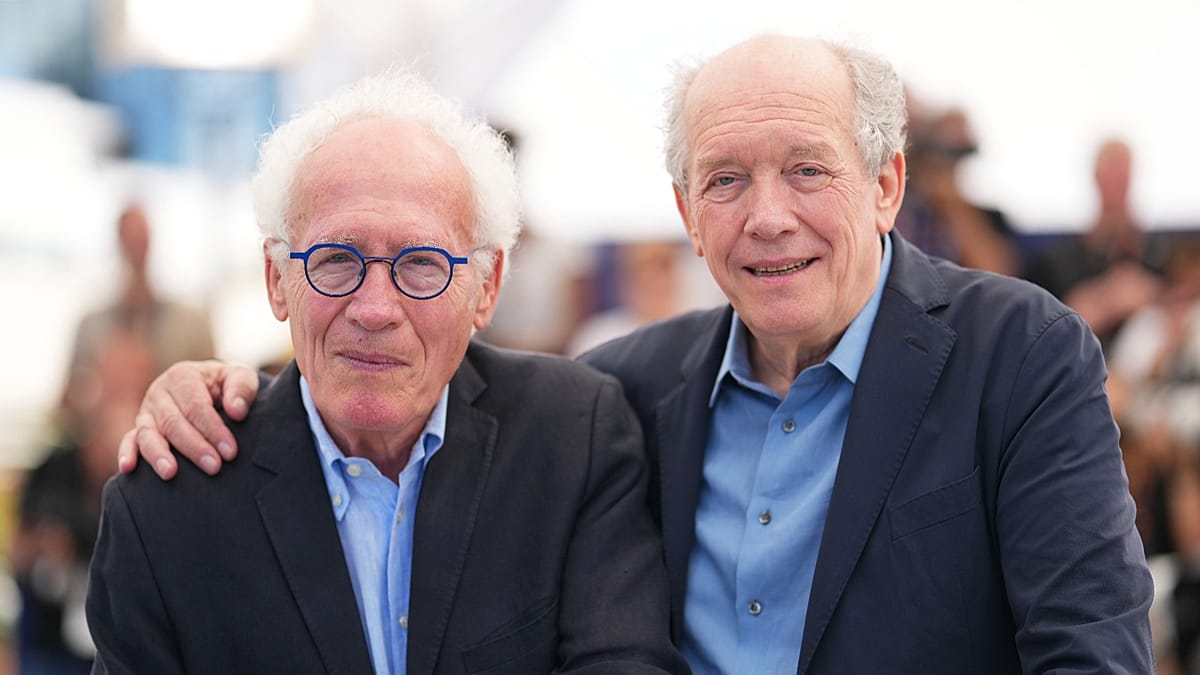
Jean-Pierre and Luc Dardenne will receive the European Lifetime Achievement Award from the European Film Academy, in recognition of their body of work. Euronews Culture sat down with the filmmaking duo to discuss the prize, the perils of AI, and the evolution of European cinema.
Celebrated Belgian filmmakers Jean-Pierre and Luc Dardennes will be the recipients of next year's European Film Awards' Lifetime Achievement Prize.
The directing duo, famous for their humanist and compassionate dramas, have been two of the leading figures in European independent cinema for almost 40 years. They have won six prizes in Cannes over their illustrious career – including two Palme d'Or awards for Rosetta and L'Enfant (The Child).
Their most recent prize was last year for Jeunes Mères (Young Mothers), which won Best Screenplay on the Croisette.
Their recognition at the European Film Awards includes winning best documentary in 1997 for Gigi, Monica… Et Bianca and the European screenwriter award in 2011 for Le gamin au vélo (The Kid With A Bike).
Euronews Culture sat down with the Dardenne Brothers to discuss their upcoming EFA prize, the perils of AI in cinema, and the current evolution of European cinema.
Euronews Culture: You will receive the European Film Academy's Lifetime Achievement Award next January. What does this award mean to you?
Luc Dardenne: For us, it’s a great honour to receive this award. I think it reflects the fact that we’ve made films that have had a certain continuity. By that I mean a continuity in our artistic exploration. It’s a bit pretentious to say that about oneself, but anyway, there’s a body of work that’s trying to take shape, and I think that after a certain time, you can indeed say: ‘Well, there’s something rather unique about these two brothers who’ve been making films for about forty years’. Plus, we’re European, so the Academy probably thought: ‘Right, we should honour them!’ (Laughs)
I had the pleasure of speaking with Academy president Juliette Binoche, who told me that one of her aims was to rehumanise society through cinema. What do you make of that statement?
Jean-Pierre Dardenne: One must always be careful with statements, even if they are important. There are many examples throughout history that show us that cinema hasn’t humanised anything at all… But, it can contribute to us being human. It can help us become more human. Certain films can do that. Charlie Chaplin’s films, for example, can help us become more human, that’s for sure. It’s true that in cinema, as well as other art forms can humanise us, even though culture has never put a stop to barbarism.
Her comment reminded me of a definition of cinema that I’ve always liked: that cinema is a machine for generating empathy. It’s a definition that fits your films well, and I was wondering if you can remember the first film that made an impression on you in that respect – one that generated empathy within you?
Luc Dardenne: Among the films that have made an impression on me, as you say, and which have sparked a desire for brotherhood, friendship and mutual support, I’d mention Kenji Mizoguchi’s Sancho The Bailiff. When I first saw it, quite a long time ago now, I did indeed feel a profound human sense of compassion, friendship and closeness to the victims, the oppressed, and the people trying to build a better life for themselves.
There are films like that - films by Bresson, for example. And then sometimes there are some love stories. If I think of Truffaut’s The Woman Next Door, it’s a tragedy, but it also captures human complexity… One can feel a deep friendship, a profound sense of closeness to human beings in a film such as The Woman Next Door. We feel close to these two lovers, close to their story, their inability to love one another and yet love each other. Beyond this impossibility, we experience something very profound and very human.
That is what cinema is all about. It is not a militant language, I would say; it is a complex language. These are complex emotions. Because when Mizoguchi made his film, it was political, as it's a film in which someone breaks free from slavery... But it's also a complex story about human relationships.
You mentioned Charlie Chaplin – any specific examples that spring to mind?
Jean-Pierre Dardenne: All of Chaplin’s films. Because there is such generosity in his films, a constant spirit of civil disobedience in the character of the Tramp, and an enormous faith in life. That’s important too. It’s that sort of cinema that matters. The kind that believes in life – and that’s full of life. Chaplin’s films are full of life - they’re not like funeral dirges, and that’s beautiful. He’s not the only one, of course, but I mentioned Chaplin because he’s a bit of a benchmark for everyone. Everyone knows him, and everyone has seen at least one Chaplin film in their lifetime. Even if you don’t go to the cinema any more, you’ve seen at least one Chaplin film. It’s good that cinema lives on under the watchful eye of the Tramp.
Luc Dardenne: Then there’s Paulette Goddard in the films too, alongside Chaplin (in Modern Times and The Great Dictator). She’s brilliant as well. She brings such life in Modern Times. It’s magnificent.
Over the course of your careers, you’ve presented your films at several festivals, including, of course, Cannes. You’ve been ideally placed to bear witness to the evolution of European cinema. Do you think it’s heading in the right direction?
Luc Dardenne: We are, I would say, living through a time of great upheaval. The current situation is complex for European cinema, world cinema, but also for African cinema – because we always tend to forget about it. For them, however, the situation is more financial and practical in nature. But what is going to happen? I don’t know. As for what the situation actually is, I’m not entirely sure either.
There are several ways of looking at it. I think the perspectives of writers and filmmakers, men and women, will endure. The question is: Will they still have the technical, practical and financial means to express themselves, to criticise, to love, and to make the world love? Will that still be possible? Given the dwindling number of cinemas and the rise of streaming platforms which, whatever people may say, do require a fair amount of standardisation, I’d say that faced with such a complex situation, the only thing I feel certain about is that we’re going to have to fight.
We – the writers, filmmakers and film technicians, the cinema operators and the heads of television channels and streaming platforms as well – are people who love cinema and who do not want artificial intelligence to make films for us. We don't want actors and actresses to be replaced, or films to be edited by AI. We need to ensure that there remains a sense of humanity in cinema. We’ve got to fight for this. We’ve got to refuse to hand over all our data to artificial intelligence.
At the same time, we’ve got to use it as a tool as well, because it’s useful for certain things, but that’s the big issue today. I don’t think cinema is going to disappear as a medium. It’ll still exist – but it needs to reflect a truly human perspective from a woman or a man making a film with living beings. Making a film that’s alive.
Will that still be possible considering the maddening push towards more AI in every aspect of our lives?
Luc Dardenne: I hope so. But we have to fight for it. And freedom, too, because there is freedom in cinema. Filmmakers like Rossellini, Godard and Agnès Varda had great freedom. Will we still be able to find that freedom if the tools dictate the writing and structure of films? So I think we need to be wary of all these new tools. We can use them, but wisely and without believing we’re above them. Otherwise we'll end up being swallowed up by them. And maybe I interpret the award we’re about to receive in this light. We’re craftspeople. We work day after day on films. We do something, redo it, start again... I hope it’s that work, too, that’s being honoured.
It does feel as though there’s a new threat to cinema with each passing year – be it Covid, which closed down so many cinemas, or the rise of streaming platforms. Now, it's AI, a technology that could be described as posing an existential threat to cinema as an artform, as well as human creation in general.
Jean-Pierre Dardenne: I don’t know anything about AI, so we must be very careful not to turn conversations into pub debates, so to speak. The other day I heard a doctor from a Belgian hospital talking about how treatment for a certain type of cancer will become increasingly personalised. He explained how artificial intelligence enables them to process a whole range of data and analyse it. He said that without artificial intelligence, you couldn't do that. So, this technology could be something marvellous. But it’s the same with everything – it depends on how we’re going to use it. Of course, there are people whose sole obsession is profit at any cost. It’s propaganda at any cost. They were certainly like that before, so this artificial intelligence will be a means of amplifying their actions and their thirst for profit. But there are others too, for whom it can be a source of help, a working tool. I think that’s what it can be - a working tool.
Luc Dardenne: In medicine, in ecology, in all the areas we need to monitor in relation to climate issues… Artificial intelligence will play a real role, that much is certain. But when it comes to art, to cinema – which is most affected – for us, it’s a mechanical art form. If we ever confuse the simulacrum with reality, we’re done for – and society is done for too.
Jean-Pierre Dardenne: Yes, but the fact that we’re talking about it proves that this isn’t yet the case.
Luc Dardenne: But there are some who would do nothing to stop it because it’s very lucrative, and we have to stand up to them.
Thanks to your films, as well as those by directors such as Emmanuel Marre, Lukas Dhont and Michael Roskam, to name but a few, Belgium has been gaining an increasing amount of internation recognition. Would you say that Belgian cinema is in good shape?
Jean-Pierre Dardenne: When I look back at when we started out, making our documentaries, I get the impression there’s more going on now. More richness. I’m not talking about financial wealth – I’m talking about the richness of films, of the variety of films available compared to 40 or 50 years ago. There’s certainly a wealth of filmmakers, including those whose names you’ve just mentioned. There are others too. And not just in fiction, but in documentary as well, which has always been an important movement in our cinema. Because, in Belgium, we had limited resources, and the documentary genre allows you to work with fewer resources. In that respect, I’d say it’s doing well, but it’s also a victim, like everyone else in European cinema, of the financial difficulties we face.
We’re lucky here to be close to France… And most of our films – even Dutch films – are largely produced in collaboration with the French film industry. All of us in Europe are incredibly fortunate to have the ‘cultural exception’ – which was championed by France. That is why it is also important that Europe awards prizes to filmmakers. If Europe were ever to decide to abolish the ‘cultural exception’ and treat culture as just another commercial product, it would be a real disaster. Our safeguard is really the cultural exception. It is this that still allows European cinema to exist today in all its diversity and richness.
Granted, but there are threats in France too. We’re seeing this with Vincent Bolloré and Canal+, who say they’re going to cut back on their support for the film industry. These budget cuts will, of course, have an impact on French film production. It feels as though cinema is at risk of losing its importance in society and that culture is increasingly becoming a commodity to be consumed – or worse, neglected.
Luc Dardenne: We have championed the cultural exception alongside Michel Hazanavicius and other French filmmakers, as well as German and Finnish directors... We’d already noticed that the commissioners responsible for cinema, industry, the economy would say to us: ‘Is it really a good idea to keep defending this cultural exception?’ There was Borgen, the series… ‘Look, the Danes have translated it into every language and everyone loves it. And it was done in Denmark. Tomorrow, it’ll be done elsewhere. Do we still need to defend individuals, filmmakers who create unique works? We’re moving towards a cinema of TV series', and so on... We fought against that.
We’ve got nothing against TV series – there are some very good ones, including the one I just mentioned, for that matter. But we said, ‘Ladies and gentlemen, you must understand that the film industry is about jobs.' There are economic considerations to think of and it’s important to talk about that. It’s also about perspective, shared by millions of Europeans, and others too. It’s millions of people who are watching a unique work. And when they come out of a cinema, after they’ve seen a film, people talk amongst themselves. They’ve seen the film, then they re-watch it whilst discussing it, and that sparks debate. It’s a public debate and that's part of democracy. Someone is offering you a vision of the world, of reality. Whether it’s a science-fiction or a realistic one, you talk about it. It’s an invitation to debate that they’re giving you.
If we abandon cultural exception, we’ll end up with a system dictated by profit. We’ll end up with the lowest common denominator, and we’ll have no more individuality. Let individuality exist! Give us the money, for goodness’ sake! Do your jobs as Europe’s political representatives! They need to remember that culture isn’t just another commodity. People think, reflect, are moved – and their emotion is thought.
Emotion is thought...
Luc Dardenne: People tend to forget that. It isn’t something we experience and then forget. No, it stays with us. We’ve all been moved by a scene in a film… And if these scenes all end up looking the same, we won’t be moved by them anymore. It’ll pass, we’ll consume them, then forget them straight away. I hope we really do hold on to this. Here, as my brother said, is where Europe has a major role to play. Maybe this award they're giving us is a way of saying: ‘Here are two unique individuals making unique films. This must continue.’
Are there any recent films that have stood out and made an impression?
Luc Dardenne: La Gradiva. That’s a very good French-Italian film by Marine Atlan. It’s a beautiful film that made an impression on both of us. We saw it a few days apart. But you see, there are two of us – my brother saw the film in Liège, I saw it in Brussels. We ring each other up and talk about the film. You can multiply that by hundreds of thousands of people. We watch a film, we talk, we discuss, and that gets people talking about society. So cinema contributes to the debate that, I hope, brings about change and moves things forward.
Jean-Pierre Dardenne: It’s the lastest one we’ve seen and I think it’s one of the greats. It’s one of the films which has moved me the most recently. And it’s a fine example of a film that’s truly alive.
Luc Dardenne: She worked, she edited, she researched, she slept poorly, she suffered… And then she was happy because she found a solution… That’s what art is all about. It’s not always pleasurable, far from it. Things don’t go to plan. We fail. We start again. And blimey, we’ve messed it up! What do we do? We’ll try to re-edit… We search and we find things. It’s marvellous. It remains a marvellous profession.
What advice would you give to young filmmakers who want to get started in this marvellous profession, as you put it?
Jean-Pierre Dardenne: You need to be around other people. You need to have friends. These days, you can make films with groups of friends, and with a mobile phone. Get going and try things out. Watching films is good too - and I’d recommend to go see the film we’ve just been talking about… To see how a young female director today manages to retain that uniqueness, that richness and that freedom. Because it’s not easy, we know that full well, and you have to fight your way through. Then there's this excessive drive to succeed... We get it. Nobody wants to fail. But this obsession with success and recognition is terrible. Here, with La Gradiva, we see that amidst all that, there’s this woman who succeeds, who really brings something to the table. It’s not just another film.
Your latest film, Jeunes mères, was screened in Cannes last year and won the award for best screenplay. If I’m not mistaken, that’s your sixth award on the Croisette. Where do you keep them all?
Luc Dardenne: (Laughs) There weren’t as many awards in the past – there used to be certificates, scrolls of paper… We’ve had two Palmes d’Or, and then, it’s true, there are other awards for screenplays, for directing… They’re in the producer’s office!
**So it's not a timeshare / "three in one household, three in another" deal? **
Luc Dardenne: (Laughs) No, not yet!
Can you tell me about your next project?
Jean-Pierre Dardenne: If things go as we’d like them to, we’re hoping to start filming next year… In September or October. That’s all I can tell you, but we’re not at all certain at the moment, given that we have zero euros.
Given what is happening in France, Italy and Belgium – I'm referring to student protests and demonstrations against the high cost of living... Considering your films, which deal with everyday life and survival in a society that exacerbates everyday problems, do these social movements serve as a source of inspiration?
Luc Dardenne: The script for our next film was finished before these events took place, so I can’t say they served as a source of inspiration. But the calls for greater justice help us a great deal. We draw a great deal of inspiration from reality, from these struggles, which are sometimes individual, unknown, even almost clandestine, if I may say so. So, naturally, we’re interested in them. And it’s excellent that young people in France and in Belgium are making concrete demands. It’s not just about being against this or that... They’re asking for concrete things that a democratic state should normally be able to provide. Education is a common good. This common good must exist, and it must exist in the finest possible way in a democratic society. There is a real problem, and it’s not just in France – it’s everywhere. Let’s not even mention the United States!
Social rights are, thankfully, being highlighted today - namely the right to food, to education, to healthcare. That's why the Democrats in the United States won. It’s because people remembered that social justice and economic justice do exist, and that they are fed up with living on the equivalent of €1,500 a month… A family with two children, who have to find a way to send them to school, put food on the table, go for a walk, take a holiday – it’s no longer possible. And people sense this, and they think: ‘They’re taking the piss, they’re no longer interested in us, they don’t care about us.’ Our films, whilst not being activist or political, etc., have always featured characters trapped in an economic and social situation linked to poverty and material hardship. That, for us, is very important. And the film we’re going to make is still part of that tradition, if I may say so. It’s about people who find themselves in a difficult situation that traps them, and they’re fighting to break free from it.
Finally, I recently had the pleasure of attending this year’s Lumière Festival, which honoured the Coen brothers. They work together but also separately. What about you? Are you or have you ever been tempted to go your separate ways for a while?
Jean-Pierre Dardenne: (Laughs) Clearly not so far! I don’t know what’s always going on inside my brother’s head… For me, it’s never crossed my mind. In 20 or 30 years’ time, perhaps! (Laughs)
Luc Dardenne: With all due respect to the Coen brothers, I think they’re better as a pair!
I must admit, I rather agree with you...
Luc Dardenne: (Laughs) They’re going to work together again, I suppose?
I understand they’re going to do something together again.
Jean-Pierre Dardenne: Great. I must say that it’s more relaxed when it's the two of us! (Laughs) More relaxed, in the best sense of the word. We talk, we exchange ideas, and if you’ve been doing that all your life and then at some point you go your separate ways… I don’t know many filmmaking couples who’ve had the same kind of solo careers as they did when they were together. If we work together, it’s not down to chance. There’s also a sort of chemistry… As the saying goes, one plus one equals three! (Laughs)
Luc Dardenne: After working together for 40 years, we'd feel alone if we were to separate, as if a part of ourselves were cut off.
It's the samething with bands. When they split up, there's always this wish that they'd get back together... As you say, one plus one equals three…
Luc Dardenne: To go back to the start of the interview and what you called empathy... Empathy is what art is all about. In fact, even behind the camera, we always work with the same team. We love working with the same people we’ve gotten to know over the course of about fifteen films! A work of art creates bonds.
The Dardenne brothers will receive their EFA Lifetime Achievement honour at the European Film Awards on 16 January 2027 in Athens.