
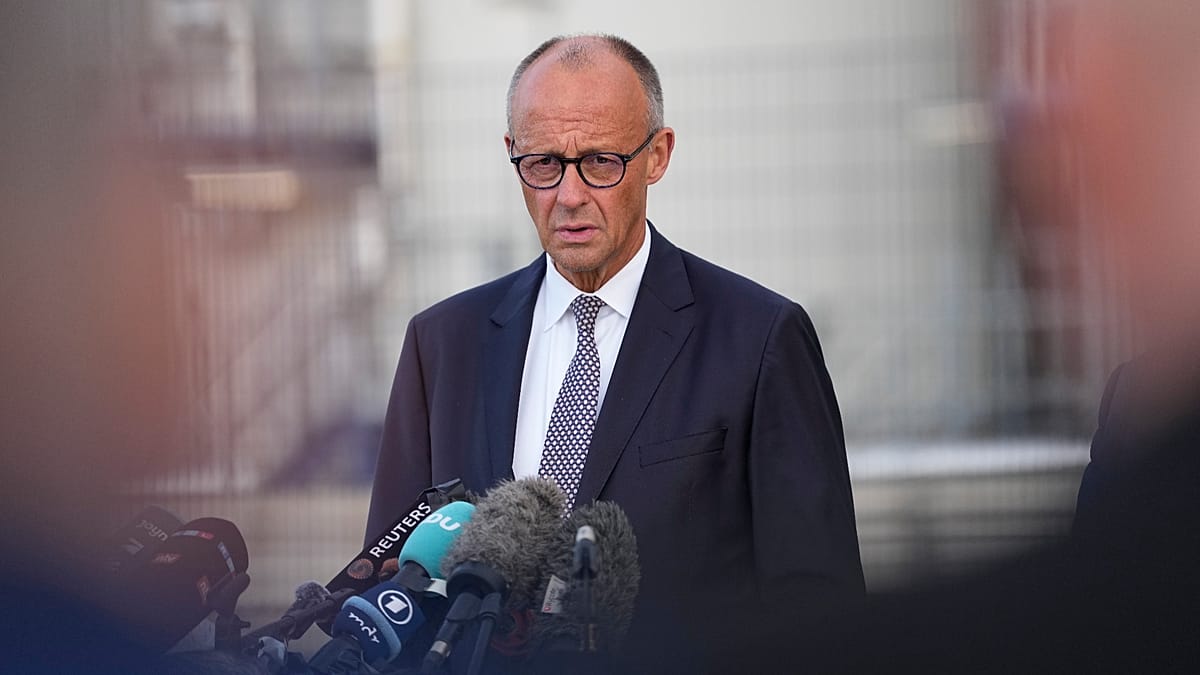
Germany's Chancellor Friedrich Merz under pressure after far-right election triumph
The ballot box triumph put the pro-Trump and Moscow-friendly AfD, officially listed as "right-wing extremist" by Germany's domestic intelligence agency, within reach of running its first-ever state government.
German Chancellor Friedrich Merz will huddle with his CDU party on Monday to discuss and digest their thumping defeat at the hands of the far-right AfD party in a state election in the ex-communist east.
The anti-immigration Alternative for Germany (AfD) scored its biggest win yet on Sunday with 44% of the vote in the Saxony-Anhalt, against around 18% for the centre-right CDU, according to broadcasters' projections.
The visibly dejected CDU state premier Sven Schulze said his campaign was not always helped by national government policies, saying that "we often faced headwinds, and that wasn't always easy."
The ballot box triumph put the pro-Trump and Moscow-friendly AfD, officially listed as "right-wing extremist" by Germany's domestic intelligence agency, within reach of running its first-ever state government.
However, it appeared to have fallen just short of an absolute majority, setting the stage for lengthy haggling before a new government is formed in the state assembly in Magdeburg.
Nonetheless, the result sent shock waves through Germany, which in the post-war era had so far managed to keep far-right parties at bay.
"For the first time since the end of World War II, the AfD, a party whose state branch is classified as right-wing extremist, is close to securing an absolute majority," said Daniel Guenther, the CDU premier of Schleswig-Holstein state. "This is a shocking moment for our country."
AfD winner mocks Merz
For Merz, who watched the results come in from Berlin party headquarters late on Sunday but did not speak in public, the result is another blow at a time when his approval ratings have dipped sharply.
The AfD's triumphant lead candidate in the state election, 35-year-old Ulrich Siegmund, took pleasure in mocking 70-year-old Merz, calling him "a very good campaigner" for the AfD.
Siegmund said his party had "made history" and that voters had sent "a signal to Berlin." Every day with Merz in the chancellery was "one day too many," he added.
AfD national co-leaders Alice Weidel and Tino Chrupalla urged the state branch to seek to take over the government, viewing it as a blueprint for national elections in 2029.
According to projections by German public broadcasters, the AfD fell just three seats short of an absolute majority of 42 seats in the regional parliament.
In the other camp, but also without a clear majority, is a grouping of parties opposed to the AfD; the CDU, centre-left SPD, Greens and the far-left Die Linke.
One option would be for the tiny BSW, a leftist party that veers hard-right on immigration, to act as kingmaker, provided it manages to cross the five-percent hurdle to enter parliament.
The AfD could also try to poach lawmakers from other parties who might want to defect and join its ranks.
Siegmund said his party stood ready to "extend a hand to all forces that want to bring about a fundamental political shift with us."
'Watershed moment'
Rumblings of discontent meanwhile came from within the CDU, which is ruling Germany in coalition with centre-left Social Democrats.
Dennis Radtke, chairman of the CDU's employee wing, called Sunday's vote a "watershed moment" and said that "the usual platitudes about a 'bitter evening' and the need for analysis won't cut it."
Thorsten Frei, leader of the centre-right parliamentary group, called for calm and noted that the chancellor was elected for a four-year term.
He therefore warned against drawing "wrong conclusions" from the result in Saxony-Anhalt.
Political scientist Oliver Lembcke of Ruhr University Bochum agreed however that the election result is "more than a severe electoral defeat for the CDU."
"We are witnessing a tectonic shift in the party system," he said.
"A protest and opposition party is transforming, at least in parts of east Germany, into a party with a realistic prospect of holding power."
The AfD, founded in 2013 as a eurosceptic protest party, soon transformed into an Islamophobic and anti-immigration party, railing against the open-door policy of former CDU chancellor Angela Merkel.
Merz has vowed to return the CDU to its conservative roots and launched a crackdown on irregular immigration while trying to reboot a stagnant economy.
Lembcke recalled that last year Merz "took office with the promise of pushing back the AfD, yet instead, the party has grown even stronger, despite the Union's shift to a more conservative course."
"This confronts Merz with a question of renewed urgency: what strategy can the CDU use to reverse this trend?"