
Extra Edition: Iran mourns Khamenei united against Trump – and uncertain of its future
Good afternoon. This is an interruption to your regular First Edition programming.I appreciate it’s unusual for us to make a post-breakfast appearance in your inbox. Only, all week we’ve wanted to bring you...
Good afternoon. This is an interruption to your regular First Edition programming.
I appreciate it’s unusual for us to make a post-breakfast appearance in your inbox. Only, all week we’ve wanted to bring you an update on events inside Iran, and quite honestly, Nigel “making money is not a crime” Farage just kept getting in the way. And so today, we bring you this one-off Extra Edition.
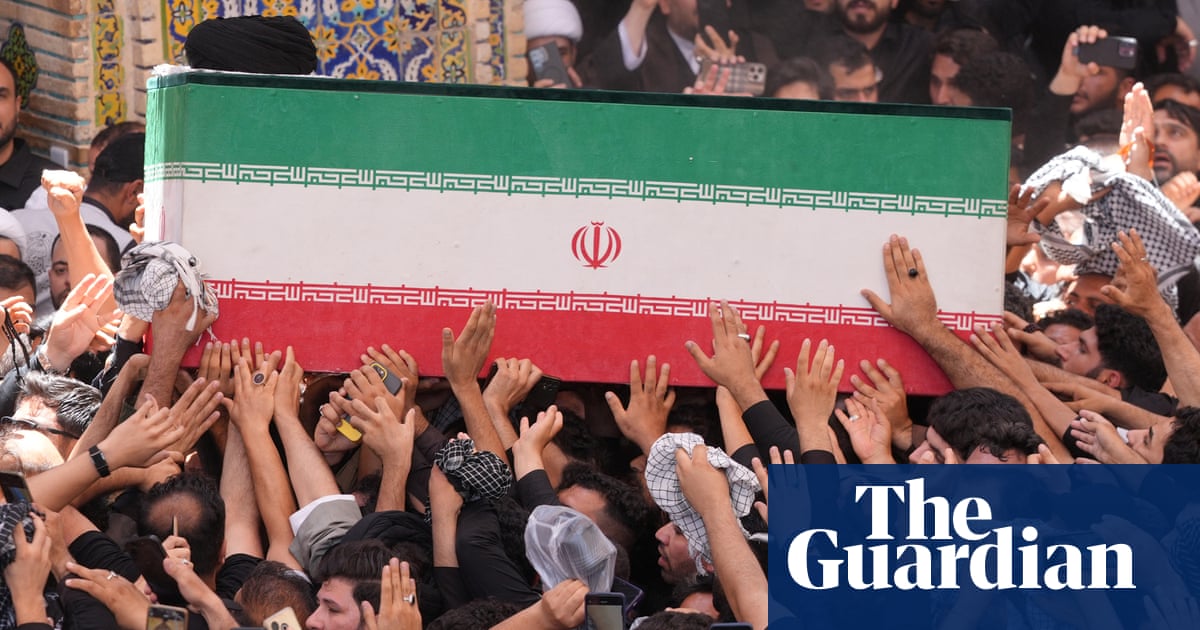
It has been dubbed the “funeral of the century”, though admittedly by its organisers. After a week of elaborate events across Iran and Iraq to mourn the late supreme leader’s death, today Ali Khamenei is being buried in his home town of Mashhad.
It’s all happening against a backdrop of waves of US airstrikes on Iran, as Trump declared the fragile, never-quite-fleshed-out truce “over”, with 170 targets claimed to have been hit during the past two nights.
It was in similar circumstances that the 86-year-old Khamenei was killed, along with much of his immediate family, when the US/Israeli airstrikes first began in February. This week’s long-delayed events – with millions taking to the streets for processions, protests and public outpourings of patriotism and grief – mark the final episode of his almost 40 years in power. In March, Khamenei’s son Mojtaba replaced his father as supreme leader. Before his appointment, Mojtaba was a mid-ranking, somewhat elusive cleric. He has yet to appear in public.
I spoke to Dr Evaleila Pesaran, a fellow at the University of Cambridge specialising in the politics of power in modern Iran, about the unique role of the supreme leader, and the significance of this transition of power. Plus, Patrick Wintour, our Diplomatic Editor, has the latest from Tehran.
In depth: ‘Many people were only there because of how America attacked Iran’
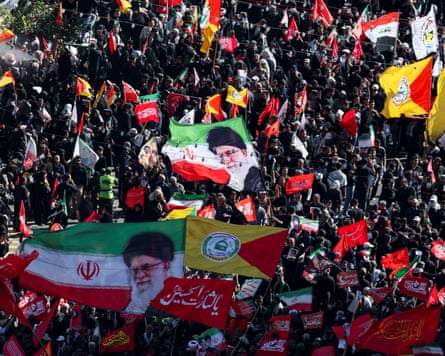
It appears the most remarkable of turnarounds for the Iranian regime. Barely six months ago, the nation’s streets were made ungovernable by waves of protests – a communication blackout saw the internet taken down. Massacres and executions followed: some estimate 30,000 were killed by the state.
Since then, countless military and civilian sites have been battered by US/Israeli warplanes, killing thousands, including much of the Iranian leadership. Regime change was (at points, at least) the stated motivation for intervention. Certainly that was Israel’s wishful thinking. What exactly this latest bout of US bombing aims to achieve remains a mystery.
“What I’ve seen is a story of two Tehrans,” Patrick told me from the city. “Yes, the streets here are full, but so were the roads out. With an extended holiday in place for the funeral, plenty of Tehran’s residents took the opportunity to head north to the sea and their holiday homes.”
He heard a wide range of views from those who remained in the capital. Whether or not they attended the funeral march, or support the regime, one refrain came up repeatedly. “Many people were only there because of how America attacked Iran. They’re not supporters of the government, but couldn’t stomach their leader being assassinated, and their country destroyed.”
However tightly choreographed and meticulously controlled, scenes this week in Tehran and beyond highlight what was already clear: for now, the regime maintains a grip on power. US foreign policy failures and violent repression have played their part in consolidating this – and western onlookers were often more optimistic of the potential of popular protests to usher in a new era in Iran than its residents – but the killing of Khamenei also proved not to be the catalyst for change Iran’s enemies desired.
The scale of this week’s funeral, despite the renewed US bombing campaign, reflects the unique position Iran’s supreme leader holds, transcending politics and religion.
Institutions of power
Only three people have held the office of supreme leader: revolutionary Ruhollah Khomeini from 1979-1989, his successor Ali Khamenei until his death in 2026, and now 56-year-old his son, Mojtaba.
Iran’s political structures are complex. “Convoluted, even,” says Pesaran. “There are democratically elected positions: the president, a parliament with limited power.” On economic strategy, and foreign diplomacy, they play a major part.
The supreme leader, in fact, has de facto control over these electoral processes, through his proxies on the 12-member Guardian Council – six of whom he selects directly. Alongside other tasks, the Guardian Council vets and vetoes all parliamentary and presidential candidates. And vet they do: ahead of the 2024 presidential election, only six out of 80 hopefuls were approved to run.
His sphere of influence extends far further, “charged with safeguarding the Islamic system – Nizam in Persian – and approves almost every governance decision. He is the head of the armed forces, state media and has a representative inside every ministry. It’s a shadow government, as it were, wielding power quietly.” Recent repression of protest and dissent, adds Pesaran, is also very much in his domain.
Supreme leaders aren’t elected, but chosen by the Assembly of Experts. The public votes for the 88-strong body of “virtuous and learned” religious leaders. They appoint, then monitor and (theoretically) can dismiss the supreme leader. In practice, the Assembly of Experts has never collectively utilised the latter power.
The constitution entrenches the supreme leader’s power, “while a web of institutions and infrastructure centred around him wants to hold on to the status quo,” says Pesaran. “Some regime support is ideological, but others are motivated by economic interests, or self-preservation. Capillaries of power spread deeply and widely into Iranian society that prop up the supreme leader, rather than him simply holding them all tightly in his clutches.”
A revolutionary idea
Nearly a decade before the 1979 Iranian revolution, an exiled Ruhollah Khomeini floated the prospect of his future position. “His idea was that the Supreme Leader would be a primarily religious role,” says Pesaran, “shaping government to be more moral, and authentic to Iranian culture and beliefs.” It was a response to the rule of the then Shah. “His opponents felt he was bringing in immorality and ‘westoxification’ – Gharbzadegi, in Persian – the corrupting influence of western cinema, fashion and ideas.”
“Many in the revolution did not share a vision for clerical rule,” says Pesaran, “and Khomeini himself declared he had no interest in politics. The revolution involved communists, leftists, nationalists, democrats … who hoped Iran would become a democracy.”
Post-revolution, the Supreme Leader job spec was designed in Khomeini’s image: a fine balance of political and religious experience. “A spiritual, learned leader who had reached the high rank of Grand Ayatollah in the state religion of Twelver Shi’ism.”
A swift shift followed. “The Islamic Republican party over the next decade was brutal in eliminating threats to the system.” This included expanding the supreme leader’s political sway during the Iran/Iraq war in the 1980s.
after newsletter promotion
Iran’s second supreme leader, Ali Khamenei – a former president – ruled in his predecessor’s image. (For more on Khamenei’s approach to power, this 2008 pamphlet by Karim Sadjadpour remains obligatory reading). Now his son takes the reins – less qualified, religiously, than his predecessors. “The revolution aimed to rid Iran of monarchy, but it now looks suspiciously like a hereditary position.”
A funeral for the ages
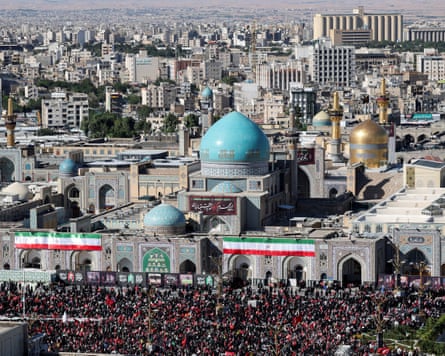
Patrick’s dispatches from Tehran capture the mood at the six-day funeral. “We the people are Iran’s true missiles,” one banner read. Violent anti-Trump chants echoed loudly. As Patrick told me: “It was impossible not to take away the key message as revenge.” Those in attendance coalesced around anti-American sentiment.
People are mourning different things, Pesaran continues: “loved ones lost in the war, attacks on infrastructure and cultural heritage. They can’t afford to buy a bag of rice – [it’s] the same as a working person’s monthly wages.” Inflation hit 88.60% percent in June. Iran’s population is more than 90 million. “Among them of course are genuine supporters of the system. The culture of grief within Iranian Shiism is far from the British stiff upper lip. At a funeral, you sob and wail.”
Now the final burial rites are complete, a new chapter in Iran’s political history begins. Only, its central character remains invisible. Rumours that Mojtaba would emerge from hiding for his father’s funeral never came to fruition.
If and when Mojtaba appears, Pesaran expects some change will inevitably be forthcoming. “He appears to view the world in a similar way to his father,” she says. The two were close: Mojtaba was part of his tight-knit inner circle. “But, Mojtaba’s close ties to the Islamic Revolutionary Guard Corps (IRGC) will have made him aware of how bad killing all your customers is for business.” The IRGC is not just a security force in Iran, but a major employer and financial actor.
Certainly, Mojtaba is close to conservative clerical factions, but his lack of prior public life makes him something of an unknown entity. “And with total economic collapse, as and when peacetime returns, he will be forced to deviate from his father’s approach if he hopes to maintain any sense of domestic legitimacy, or to create economic recovery. I would expect some pragmatism – he’ll need to gain credibility.”
All that remains to be seen. For now, at least, Iran’s most powerful figure is invisible.
We’ll be back at our scheduled time tomorrow morning.
What else we’ve been reading
-
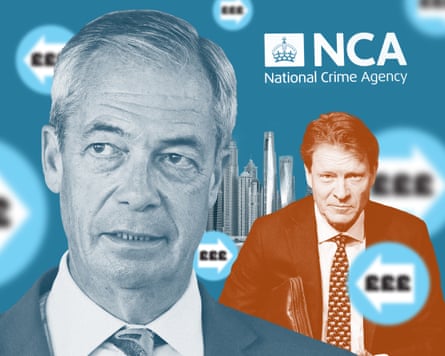
Ahead of tomorrow morning’s First Edition, why not have a look at our fantastic reporting on Nigel Farage, led by Anna Isaac, and the questions surrounding the large sums of money flowing into his bank account.
World Cup 2026
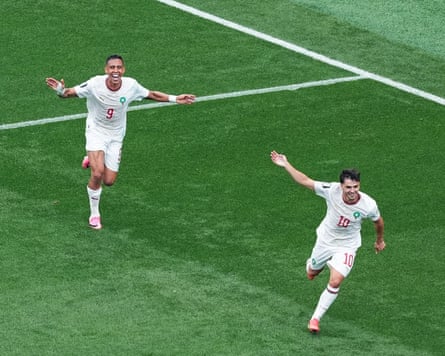
France v Morocco | Kicking off at 9pm (BST) tonight, the first of the quarter-finals is a mouth-watering tie between the favourites, France, and one of the dark horses for the tournament, Morocco – who could field six players born in France in the match.
Bored at work?
And finally, the Guardian’s puzzles are here to keep you entertained throughout the day. Until tomorrow.